The diner smelled like coffee, dust, and hot grease, the kind of place where strangers came in tired and left quieter than they arrived. Its neon sign stuttered like an old heart, Route 66 humming beyond the glass with the steady patience of a road that had seen too much. A ceiling fan pushed heat around in slow circles. The day shift had long surrendered to evening, and the waitress—thin, sharp-eyed, tired in a way that didn’t require explanation—kept refilling cups as if the world could be measured and mended in ounces of bitter warmth.
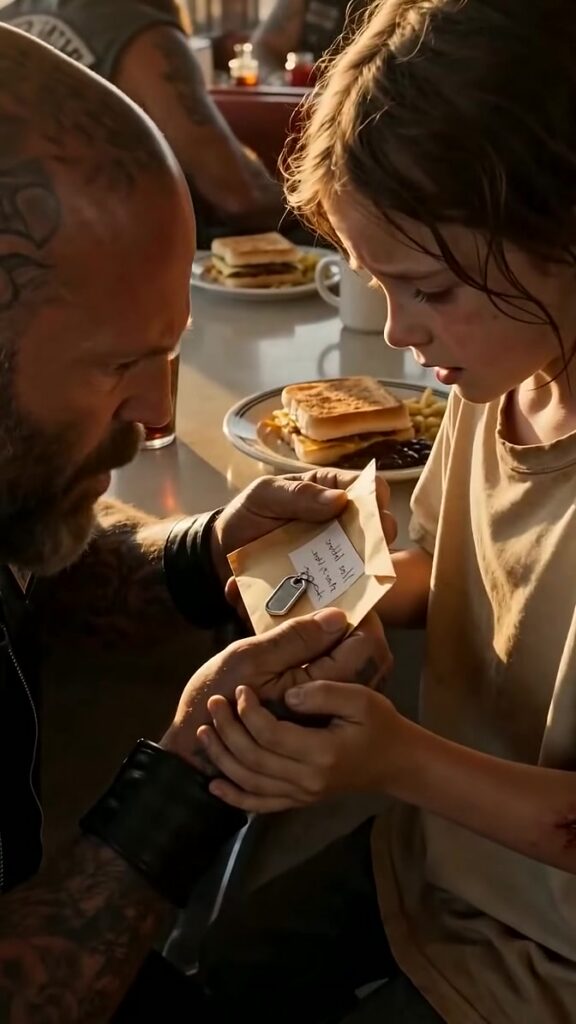
In the corner booth, a bald biker with arms inked in black and blue shadows leaned close to a little girl who looked borrowed from someone else’s life. Her oversized beige T-shirt hung on her like a hospital gown. Her hair was knotted as if combs had become enemies. Under the amber diner light, her skin held the faint, sickly cast of fear that had run out of places to hide.
He was careful with her—careful in the way men were only careful when they’d already lost something and never wanted to lose it again. He used two fingers to catch the edge of medical tape on her forearm. Beneath it, a patch of skin was angry and raw, ringed with red as if something had clung there too long. When the tape peeled free, the girl struck like a trapped animal. Both hands flashed up, catching his wrist hard enough to make him flinch. She pressed a small envelope into his palm with frantic insistence.
“Read it,” she whispered. The words were thin, scraped raw by terror. “Quick.”
His eyes flicked from the mark on her arm to the envelope, then toward the front windows as if instinct had a better view than sight. “What did they do to you?” he asked, voice low enough to stay inside the booth. The girl’s gaze darted to the sunlit strip of highway beyond the glass. She looked like she expected the sky to crack open and spill men with guns.
“They put it on me,” she said. She didn’t say what it was, but her tone held the weight of a thing that didn’t wash off. Around them, other bikers sat scattered at the counter and in booths—leather vests, road dust, tired faces. One turned in his seat, watching. Another set his coffee down too carefully, as if the mug might shatter from the wrong kind of attention.
The bald biker tore open the envelope with the impatience of someone who knew time was a knife. Inside was a folded note, creased and refolded in the way desperate hands did when they didn’t know whether to keep or destroy something. A small metal tag slid out after it and clinked softly against the tabletop. It wasn’t military, not exactly—no chain, no standard stamping—but it had the same cold authority. He picked it up, and something in his face tightened so fast it looked like pain trying to hide as recognition.
Engraved into the metal, neat and merciless, was a name he had once spoken into a grave. Lena Mercer. Ten years. Ten years of riding through towns that blurred together, of waking to the taste of old regrets, of telling himself the past stayed buried because it had to. He stared at the tag as if it had just unlocked a door inside him that he’d welded shut with his own hands. When he looked back at the girl, his voice was suddenly different—harder, anchored. “Who gave you this?”
Her eyes filled, overflowed. The tears came fast, like she’d been holding them in with teeth and nails. “My mom,” she said. “Before she ran.” She swallowed, shaking. “She told me if anything happened… if they caught us… to find the diner with the bent neon, and the man with the skull ring.” Her gaze dropped to his right hand. The skull ring was there, dull with road wear. “She said you’d know what to do.”
Outside, an engine rumbled. Not the casual rumble of a traveler pulling in for pie, but the heavy growl of a threat with purpose. Then another. Then a chorus, growing closer, swallowing the road’s quiet. Shadows streaked past the windows like dark fish in dirty water. Every biker in the diner turned toward the glass, bodies tightening, chairs shifting back. The waitress paused mid-step with a coffeepot in her hand, listening like a hunted animal.
The girl heard it, too. She grabbed the biker’s vest with both hands, fists bunching leather at his chest. “They found me,” she said, and it wasn’t drama—it was a report. His jaw clenched. In the reflection of the window, he could already see the shapes: a pack of motorcycles knifing through dust, and behind them a white truck that looked too clean to belong on this road.
“No more talking,” he murmured. He slid out of the booth and pulled her down with him, tucking her behind the seat as if he could become a wall thick enough to stop a bullet. Across the diner, the others rose without being told. They moved with the practiced economy of people who understood violence the way farmers understood weather. One of them—broad-shouldered, gray-bearded—reached behind the counter and lifted the hinged panel that hid an old shotgun. The waitress didn’t protest. She only backed toward the kitchen, eyes flat, as if she’d always known this place might someday stop being a diner and start being a battleground.
The white truck skidded to a stop in front, tires spitting grit. The motorcycles fanned out like wolves taking positions. The diner seemed to inhale and forget how to exhale. The bald biker—Rafe, they called him on the road, though Lena had once used his real name like a prayer—glanced down at the tag again, because he needed to be sure his mind wasn’t playing tricks with him. The metal was cold. The engraving was real. The past was standing up from its grave and walking.
The truck door swung open. A boot hit the dirt, polished black and out of place among the dust. Then a man unfolded himself from the cab, broad in the shoulders, clean-shaven, wearing sunglasses that mirrored the diner’s flickering neon. He moved like someone who was used to rooms emptying when he entered them. Two more men slid out behind him, their hands resting casually near their belts—too casual, too ready.
Rafe kept his body over the girl, his forearm braced against the booth, eyes narrowed. The note lay open on the table where he’d dropped it, a few lines written in a hurried hand he would have recognized even if the ink had been smeared by rain: If you’re reading this, they’re close. Don’t trust the badge. Don’t trust the hospital. They branded her because she saw what they did. I’m sorry. I had to bring her to you. Tell her she was never the reason I ran. Tell her— The last words were blurred, as if the writer’s hand had been jolted, or the paper had been wet with tears.
Boots crunched on gravel outside. The front door handle shifted. Rafe’s friends spread out—one by the restroom, one by the kitchen entrance, one near the jukebox that hadn’t played in years. Not a gang, he corrected himself bitterly. Not anymore. They’d tried to be men with ordinary lives. The road kept calling them back when ordinary failed.
The door swung inward, and the bell above it gave a small, innocent jingle that didn’t belong to what was stepping inside. The man in sunglasses paused, surveying the room like he owned it. His gaze moved, landed on Rafe’s booth, then dropped—just slightly—as if he’d already counted the space behind the seat and decided what kind of trouble lived there.
“Evening,” the man said, voice smooth as oil. “We’re looking for a child.”
Rafe didn’t answer. He let the silence stretch, thick and dangerous, while his fingers curled around Lena’s tag until the edges bit his skin. Ten years ago, he’d watched fire consume a car on a back road and believed the woman inside it was gone. He’d buried a closed casket because there hadn’t been enough left to argue. He’d told himself grief was a straight line you followed until it got quiet.
Now, in the stink of coffee and dust and hot grease, the line curved back on itself. Lena hadn’t died. She’d been hunted. She’d run. And she’d left him a daughter-shaped message with a raw mark on her arm and panic in her eyes.
Rafe rose slowly, making himself visible, a deliberate target. The metal tag glinted once as he lifted his hand. “You mean her?” he asked, voice calm in the way storms were calm right before they tore roofs off houses. “You’re too late.” He didn’t know if that was true, but he knew something else with absolute clarity: nobody was taking the girl out of this diner while he still had breath.
The man’s smile didn’t reach his eyes. “I don’t think you understand,” he said softly. “She belongs to us.”
Rafe’s mouth turned into something that wasn’t quite a smile. Behind him, the bikers shifted their stance, and the diner’s air sharpened. “No,” Rafe said, and the word landed like a gavel. “She belongs to the woman you couldn’t bury.”
For a fraction of a second, the man’s composure slipped. Recognition flickered—small, betrayed—at the name on the tag. And in that flicker, Rafe saw the truth: this wasn’t a random chase. It was a long, ugly secret coming to collect its witnesses.
He felt the girl’s small hand clutch the back of his vest, anchoring him. He didn’t look down. He kept his eyes on the men at the door and let his voice drop into the register of decisions. “Lock the back,” he said quietly, and the waitress moved without question. Outside, engines idled, impatient. Inside, the diner held its breath, and every tired stranger in it became quiet for the same reason: they could feel the moment when ordinary life snapped, and something else took its place.
Rafe tightened his grip on the tag until it hurt. Pain was good. Pain meant he was here. “Lena,” he thought, not knowing if she was alive or watching or bleeding somewhere on the road. “I’m listening.” And then he did what the road had taught him when mercy ran out—he planted his feet, drew the past into the present, and prepared to make the world pay attention.