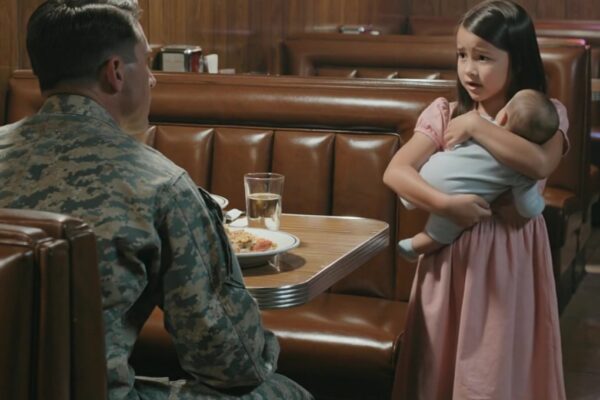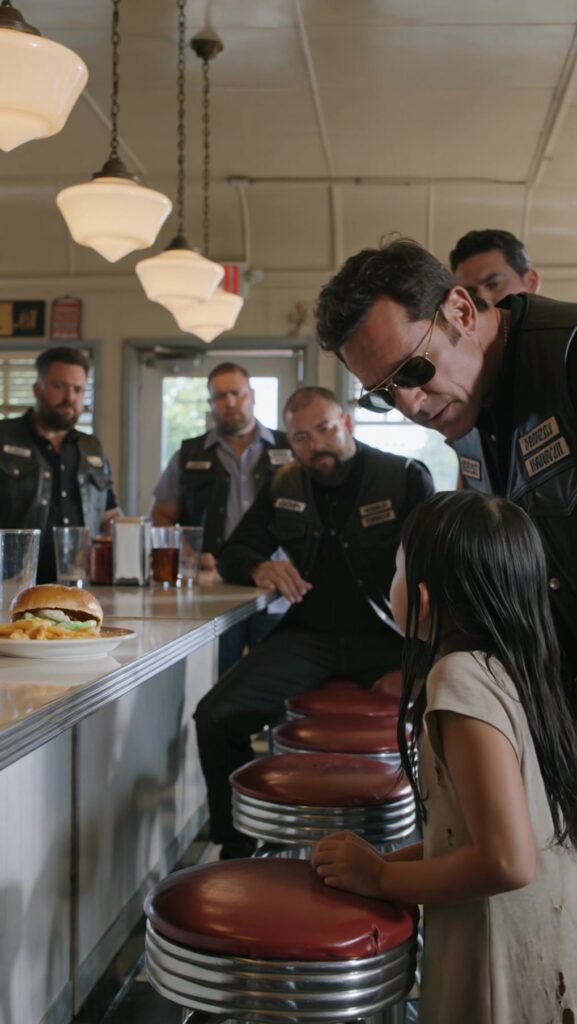
The bell above the diner door gave its tired chime and then fell quiet, as if it regretted announcing her. She stood on the checkered tile with a kind of rigid courage that didn’t belong in a child’s body. Her dress hung in torn petals at the hem, one shoulder strap snapped and knotted back together. Salt tracks shone on her cheeks, drying into pale streaks. She didn’t step farther in. She only stared down the length of the room like she expected it to bite.
At the counter, five men in road-worn leather had the kind of presence that bent air around them. Their bikes were lined up outside like iron horses, rain-beaded and hulking. They were loud men in most places, but in this diner, on this night, they were mostly quiet—talking in grunts between sips of coffee, letting the jukebox do the remembering for them.
The smallest sound from the girl—an uneven breath—made the nearest biker turn his head. His beard was streaked with gray; his vest was patched with a faded emblem of a black hound. He watched her the way you watch a deer near a highway, aware that even kindness could send it bolting.
The waitress, Marlene, set down a plate of fries and froze with the towel in her hands. “Honey?” she said, and her voice lost its edge. “You lost?”
The girl’s fingers clamped around the nearest red stool as if it were a railing on a bridge. Her knuckles turned waxy-white. She looked over her shoulder, then toward the windows, then back at the door again, counting seconds with her eyes like footsteps were due.
The bikers had seen panic. They’d seen people in detox sweats, veterans startled by a slammed door, men who’d bet their mortgage on one more hand. But this was different. This was the sort of fear that made the body stand tall when it wanted to collapse, as if falling might make you easier to catch.
The lead biker—everyone called him Rowan, though few remembered if that was his first name or the last thing he’d left behind—pushed his untouched burger away. He slid his sunglasses up onto his head, revealing eyes the color of cold steel. “Kid,” he said, gentle enough to startle the room. “What are you running from?”
Her lips parted, then closed. She swallowed as if she were trying to force down a scream. “I’m not—” she began, and then her gaze snapped toward the front windows again. Outside, the highway lay dark, a ribbon of wet asphalt under buzzing lights.
Rowan leaned closer, elbows on the counter, making himself smaller. “It’s okay to tell the truth in here,” he said. “We’re not the people you’re afraid of.”
The girl’s eyes shone. “My mom said… not to believe them.”
“Believe who?” Rowan asked, and the question carried a weight the other men felt immediately. Cups paused halfway to mouths. A fork stopped midair. The jukebox’s song reached the end of a chorus and kept going like nothing had changed, which somehow made it worse.
She wet her lips. “The men who took her,” she whispered. “They came with lights. Like police.”
Something hard passed through the bikers as one, like a cold wind through a line of trees. The man to Rowan’s left—Shank, broad as a door—set his mug down so slowly it didn’t clink. Another, a younger one with a scar cut like a lightning bolt across his eyebrow, rotated on his stool and watched the diner door as if expecting it to explode inward.
Rowan didn’t speak right away. He studied the child properly, not as a stray problem, but as a message delivered by trembling hands. “What’s your name?” he asked.
“Lila,” she said, barely audible. Then, as if the name was too loud, she leaned closer, her breath hitching. “She said don’t trust them. She said… don’t let them find me first.”
Marlene’s hand went to her mouth. Even the cook in the back, a man who never came out for anything short of a fire, leaned into the pass-through window, listening.
Rowan kept his voice calm by force. “Did your mom tell you anything else? Something meant for… someone?”
Lila nodded and cried harder, silent tears falling as if she couldn’t spare the sound. Her fingers fumbled at the pocket sewn into her ruined skirt. She drew out a napkin folded too carefully for a child. Her hands shook so much the paper fluttered like a moth.
Rowan reached, paused, and let her place it in his palm. It was warm from her body, damp at the corners. He unfolded it slowly.
A sheriff’s badge lay inside, old and rust-freckled, its edges worn as if it had been carried in a pocket for years. The star was gouged, and on the back someone had scratched a warning with frantic pressure—letters jagged, the metal scarred deep enough to catch the diner’s light.
Not a real cop.
Rowan’s jaw tightened so hard a vein jumped in his temple. Across the counter, Shank exhaled through his nose like a bull scenting blood. The scar-brow kid—Mace—went pale in a way that had nothing to do with the diner’s fluorescent lights.
Rowan had seen that badge before. Not its number, not its county stamp—those could be faked, replaced, swapped. But the damage, the sickening desperation carved into it, the way someone had tried to make the truth permanent because paper could burn. He remembered a night years ago when sirens had screamed down a back road toward the river. A “raid” that never made the news. Men in uniform with eyes too dead, hands too eager. A friend who’d disappeared afterward, the kind of disappearance that made you stop saying a name out loud.
Lila watched his face, waiting for it to become a door or a wall. “My mom said if you saw it,” she whispered, “you’d know who my dad is.”
The diner seemed to shrink around them. Rain tapped the windows. Somewhere outside, a truck hissed by on wet tires like a long breath.
Rowan looked at the badge again, then at the girl. His mind tried to push away the arithmetic: the years, the odds, the possibility that the past had reached forward and placed its hand on his shoulder. He felt every old promise he’d broken and every one he’d kept, and he knew—before he decided it—that he could not send this child back into the world alone.
“Lila,” he said, and his voice softened with something close to grief. “Your mom did the right thing getting you here.” He glanced at Marlene. “Lock the door.”
Marlene didn’t question him. She crossed the diner in three steps and turned the deadbolt with a click that sounded like a verdict.
Rowan slid off his stool. Leather creaked. The other bikers shifted too, bodies angling toward the windows, toward the entrance, toward every possible way danger could arrive. They weren’t heroes. They were men who had done terrible things and tried, in the quiet afterward, to make a different kind of meaning. But they understood predators, especially the kind that wore legitimacy like a mask.
Rowan crouched so his eyes were level with Lila’s. “Listen to me carefully,” he said. “Did anyone see you come in?”
She shook her head, then hesitated. “A car,” she murmured. “It stopped at the edge of the lot. It had a light on top. Not on. Just… there.” Her gaze darted toward the window again. “I think they’re waiting.”
Rowan stood, the badge heavy in his palm as if it were made of stone. He tucked it into his vest pocket like a sacred thing and a threat. “Then we don’t wait,” he said, and the calm in his voice was a blade.
He turned to his men. “Mace, back door. Shank, call the club—no names, just the code. Jory, kill the lights in the front and keep the kid close.”
They moved without questions, because the badge had answered them all. Rowan looked once more at Lila, at the way she gripped the stool like it was the last solid thing in a collapsing world.
“You’re not standing alone anymore,” he told her. And as the diner’s lights dimmed and the night pressed closer to the glass, Rowan felt the past stir, recognizing him at last—and daring him to do something about it.